
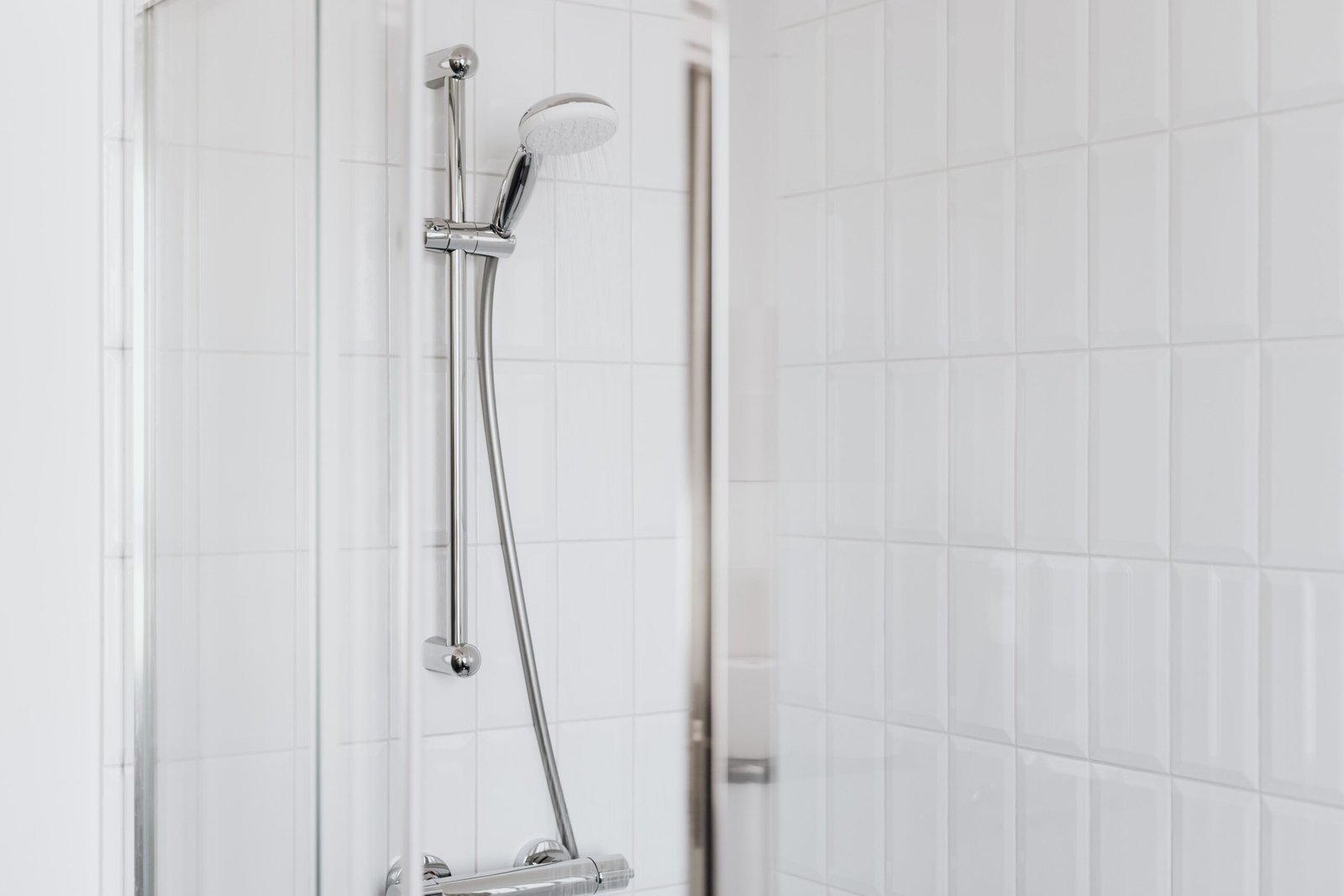
Most bathroom storage advice assumes the water stays in one place. A wet room is the room where it doesn’t.
With no screen and no tray, the whole floor is the shower. Spray reaches walls three metres away, water sits on surfaces rather than evaporating off them, and anything stored at low level gets rinsed several times a day. That’s a different problem from humidity, and it’s why storage that works perfectly well in a normal bathroom fails here within a year.
Two things determine whether anything you buy survives. Neither appears in the usual listicles.
Don’t drill the walls. Seriously.
This is the one that matters most, and it applies whether you rent or own.
A wet room is waterproofed with a tanking membrane, a continuous sealed layer applied to the walls and floor underneath the tiles. It’s the only thing stopping water from reaching the structure behind. Tiles and grout are not waterproof on their own; they’re the finish over the thing that is.
Drill into a wet room wall, and you puncture that membrane. The hole is behind the tile where you can’t see it; water tracks in through the fixing over months, and the damage shows up as staining on the other side of the wall or in the ceiling below. By then it’s a structural repair rather than a filled hole.
For a renter, this is worth understanding clearly, because it changes the conversation with your landlord. In an ordinary room, asking to put up two screws is a minor request. In a wet room, it’s asking to breach the waterproofing, and a landlord who knows what they’re doing will say no. If you were planning to ask, ask about somewhere else instead.
So wet room storage is a freestanding and non-penetrating problem by necessity. Which is fine, because there are good answers.
The failure point isn’t the material; it’s the edges
Here’s the finding that reframes the whole shopping decision.
People choose bathroom furniture by its core material, and the core matters. Particleboard is the worst, failing within a few years in wet conditions. Standard MDF absorbs water and swells irreversibly once the surface is breached. Marine-grade plywood is bonded with waterproof adhesive and has none of the internal voids that let water travel through a panel. Stainless steel and solid PVC don’t care about water at all.
But industry sources put around 80 percent of bathroom vanity failures down to poor edge sealing rather than the core. Manufacturers skip precision edge banding, water gets into the panel through an unsealed cut, and the unit is destroyed from the inside while the visible faces still look fine.
That means the useful thing to check on any bathroom furniture isn’t the material listed on the label. It’s whether every cut edge is properly banded, including the ones you can’t see: the underside, the back panel, the inside of drawer runners, and anywhere a screw hole has been drilled into the core.
Run a fingernail along an edge in the shop. If you can feel raw board anywhere, it will fail in a wet room, whatever the description claims.
A note on moisture-resistant MDF. MR MDF is a genuine improvement, and it’s the minimum worth considering for a normal bathroom. It is not suitable for a wet room. No MDF is fully waterproof, and the guidance for anywhere with direct water contact or shower surrounds is to use something else entirely.
What to actually use
Stainless steel, aluminium or solid plastic. These are the only materials that are genuinely indifferent to being rinsed daily. In a wet room they’re not a compromise; they’re the correct answer. Check that fixings and hinges are also stainless, because a stainless carcass with mild steel screws will still bleed rust stains down your tiles.
Freestanding, not fixed. Since you’re not drilling, everything stands on the floor or braces without fasteners. That also means you take it with you when you leave, which is a real advantage when you’re renting.
Off the floor where possible. Anything sitting directly on a wet room floor sits in standing water at least twice a day. Units on legs, with a genuine gap underneath, dry out between showers and don’t wick water up into the base. This one detail extends the life of a unit more than most material choices.
Closed storage for anything that shouldn’t get wet. Spare toilet rolls, medication, and anything paper needs a door, not an open shelf. Open shelving is fine for things you actively want to dry.
Storage that doesn’t touch the walls
Tension poles in the corner. A floor-to-ceiling tension pole caddy braces between floor and ceiling with no fixings at all, and gives you three or four shelf levels in a corner that was doing nothing. Look for aluminium or coated steel rather than chrome-plated mild steel, which pits in constant wet.
A tension rod across an alcove. Cheap, effective, and it presses against tile rather than plaster, which is the surface tension rods handle best. Bear in mind it will work loose over time. Between the temperature swings from hot water and the constant damp, a rod that felt solid on installation will be sagging a few months later, so plan on re-tensioning it periodically rather than waiting for it to drop.
Over-door storage. The back of the door is dry; it’s outside the spray zone, and it costs no floor space. Measure the door thickness at the top edge first, since internal doors are commonly 35mm and many over-door hooks are cut for thicker doors.
A slim trolley on castors. Probably the best value item in a small wet room. Wheel it out of the spray zone when you shower and back afterwards. Get one with sealed plastic or stainless components, not painted mild steel.
What fails, and why
Suction cups. The temperature swings break the seal, and they let go in the night, usually taking a full shampoo bottle down with them.
Adhesive hooks in the spray zone. Standard strips fail quickly in a room this wet. If you use them at all, use a water-resistant range and put them outside the direct spray, not inside it. Bear in mind that no adhesive is rated for continuous water contact.
Anything with a particleboard core. It will swell, delaminate, and start smelling of damp within a couple of years, regardless of what the laminate on the outside looks like.
Chrome-plated mild steel. It looks like stainless in a photograph. It pits, rusts through the plating, and leaves orange marks on grout that are difficult to remove.
The short version
Don’t drill, because the membrane behind the tile is the only thing keeping water out of the structure. Buy edge sealing rather than the material named in the description. Choose stainless, aluminium, or solid plastic. Keep things off the floor and out of the direct spray where you can.
A wet room is a harder room to store things in than a normal bathroom, and it rewards buying fewer, better things rather than filling it with cheap plastic that fails in a year.
More bathroom storage: small bathroom storage ideas · under-sink storage ideas
Material performance and edge-sealing failure rates from Engineer Fix on MDF and water, and industry guidance on high-humidity vanity specification. If you’re unsure whether your bathroom is tanked, ask your landlord or letting agent before fixing anything to a wall.