
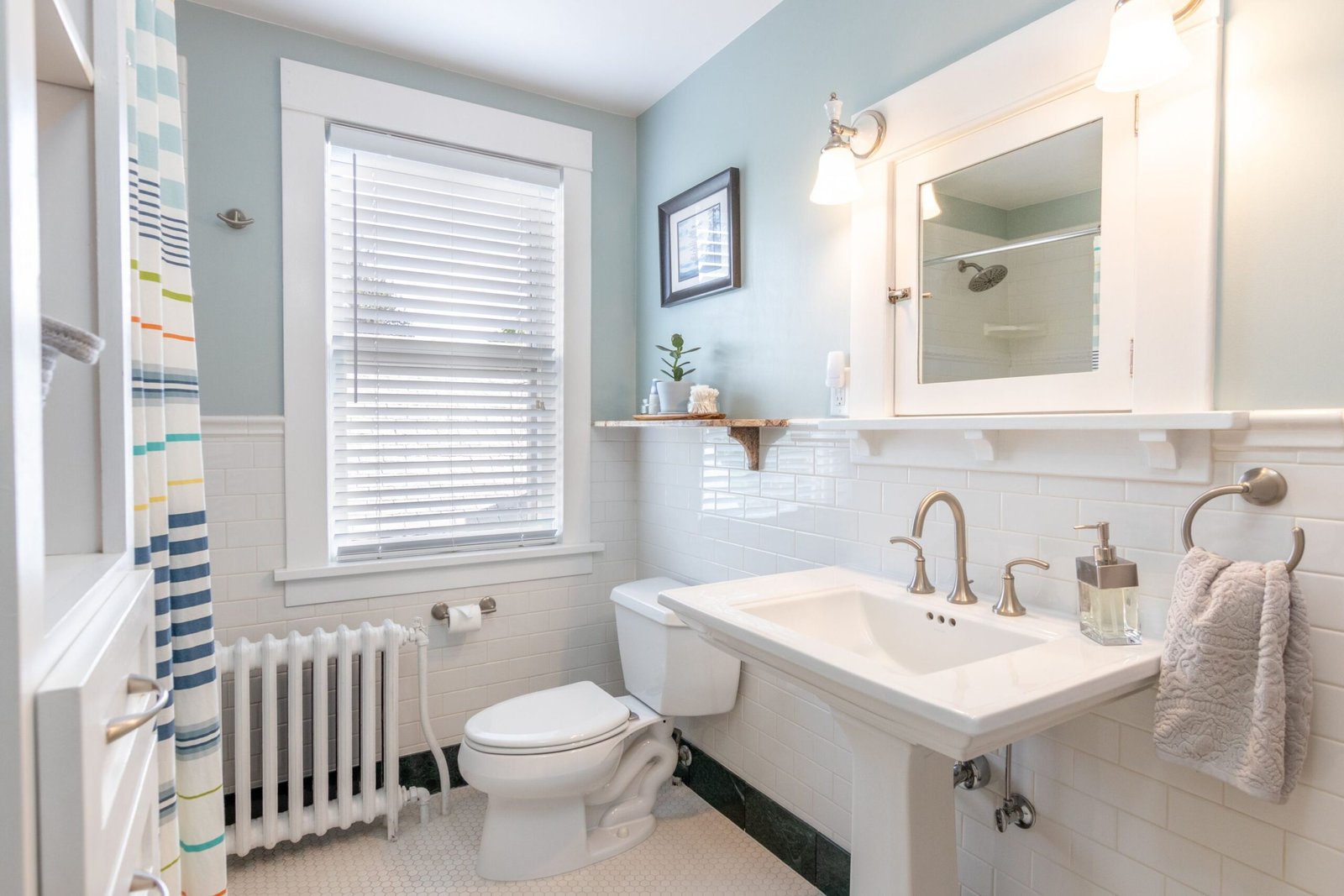
A pedestal sink is a beautiful fixture and a storage disaster. It takes away three things at once: the cabinet underneath, the counter around the basin, and most of the usable floor. And if you rent, you can’t swap it for a vanity.
Most articles about this problem show you a photo of a cabinet tucked neatly around a pedestal and move on. What they skip is the measurement that decides whether any of it works.
The number that determines everything
A standard pedestal sink is 22–24 inches (56–61cm) wide. The pedestal itself, the column holding it up, is only 11–12 inches (28–30cm) wide.
Subtract one from the other, and you get your real storage space: roughly 5 to 6 inches (13–15cm) of floor on each side of the pedestal, and that’s it.
This is why so much “pedestal sink storage” fails on arrival. Those two-door cabinets sold specifically for this job are typically around 23½ inches wide. They don’t fit beside the pedestal; they straddle the entire sink, and they need the basin to sit at a height that clears them. Many are rated to hold about 24 lb (11kg) total, which is less than it sounds once you’ve loaded cleaning products.
So before you buy anything, measure three things:
- Floor gap on each side of the pedestal, front to back and side to side
- Height from floor to the underside of the basin (this is often less than you’d guess, because the basin flares outward)
- Depth from the wall to the front edge of the sink, usually 18–20 inches (46–51cm)
Write them down and take them shopping. Everything below assumes you’ve done this.
The bathroom problem nobody warns you about
Before the ideas, one thing specific to bathrooms that catches renters out.
Adhesive hooks and strips behave differently in a bathroom than anywhere else in the house, and the standard version will eventually let go in a room that gets steamed daily. Command makes a separate water-resistant range for exactly this, marked with a blue strip on the packaging rather than the usual white. Use that one. It costs the same.
Two more things that matter more in bathrooms than elsewhere:
Tile is only half a smooth surface. Adhesive strips need a continuous flat area to bond to. On large-format tiles, that’s easy. On small tiles or mosaic, the grout lines break up the surface, and the strip has nothing consistent to grip. Find a single tile big enough to take the whole strip, or don’t use that wall.
Heat is real. The adhesive softens above 40°C (104°F). A small bathroom with a hot shower running and the door shut gets warmer than people expect, and a strip that’s been softened repeatedly loses strength permanently. This is why the towel hook that held fine for six months suddenly fails.
Clean the surface with isopropyl (rubbing) alcohol before applying, not a household spray cleaner, which leaves a residue film that stops the bond from forming. Then wait a full hour before hanging anything. And never double up two hooks to hold something heavier than one is rated for: 3M advises against it directly, because the load won’t share evenly and one hook takes it all until it fails.
1. A sink skirt: the only way to use the space under the basin
The area directly beneath a pedestal basin is dead space, hidden behind nothing. A fabric skirt attached around the basin’s rim turns it into a concealed cupboard.
Attach it with adhesive-backed hook-and-loop tape (Velcro) run around the underside of the basin lip. Ceramic is smooth, non-porous, and takes adhesive well, which makes it a far better surface than the wall beside it. You’re sticking to the landlord’s sink rather than the landlord’s paint, and it removes without leaving a mark.
Behind the skirt, you can fit a small stack of shallow baskets or a low stackable drawer unit. Measure the height from the floor to the underside of the basin first, because that’s your ceiling.
Worth knowing: keep the plumbing accessible. The P-trap and shut-off valves sit directly under a pedestal sink, and if a leak develops behind a skirt, you won’t see it until it reaches the floor. Make the skirt easy to lift, and look behind it occasionally.
2. Narrow floor storage in that 5-inch gap
Slim rolling carts and narrow stacking drawers are the products that actually fit the space beside a pedestal.
Look for a footprint under 5 inches (13cm) wide. Search terms that surface the right things: “slim storage cart,” “narrow bathroom cart,” “gap organiser.” These are usually sold for the space between a fridge and a wall, and the dimensions happen to be exactly right here.
A slim cart is probably the best value item in a small bathroom, but narrow and tall tips easily. Keep heavy items on the bottom tier, and if your floor slopes, which plenty of older rentals do, test it before you load it.
If your gap is under 4 inches, you’re into stacked shallow trays rather than furniture. Still useful for spare soap, razors, and cotton buds.
3. Over-toilet shelving: check the anchor requirement first
The classic answer to a bathroom with no storage, and it works, but read the assembly instructions before you buy.
Many over-toilet étagères include a wall anchor bracket for stability, and some genuinely need it, because a tall narrow unit straddling a toilet is top-heavy by design. That anchor means drilling.
Two ways around it. Choose a unit that’s freestanding-rated with a wide base and load it bottom-heavy. Or ask your landlord in writing whether a single anchor screw is acceptable. Many will agree, and a written yes protects you at the end of the tenancy in a way a phone call doesn’t.
4. A tension rod inside the shower or across a recess
Tension rods work by pressing outward against two surfaces, which makes them ideal in bathrooms, because the surfaces available are usually tile or a tiled recess rather than painted plasterboard.
That distinction matters. On painted drywall, the pressure concentrates on two small points and can dent the surface over months, which is damage rather than wear and tear. On tile, it’s fine.
A second rod inside a shower, mounted lower than the curtain rail, holds hanging mesh baskets for shampoo. In an alcove, it holds cleaning spray by the triggers.
If a rod starts to slip, that’s it telling you it’s overloaded. Take weight off rather than re-tensioning harder. They also work loose over time. Hot showers and damp gradually ease the grip, so a rod that felt solid on installation will be sagging a few months later. Plan on re-tensioning it periodically rather than waiting for it to drop.
5. The back of the door
The most overlooked surface in any small bathroom, and it costs you no floor space at all.
Measure the door thickness at the top edge before buying an over-door rack. Internal doors are commonly 35mm (1⅜”) and plenty of over-door hooks are cut for thicker doors. Too thick and the door won’t shut; too thin and it swings.
Be careful with weight. A fully loaded over-door organiser puts strain on hinges that weren’t specified for it, and hinge damage at the end of a tenancy is your problem.
6. Corner shelving where the walls meet
Corners are the one part of a small bathroom with genuinely spare floor space. A freestanding corner unit turns it into four shelves.
Look for one narrow enough not to intrude on the walking path between door, toilet and shower. In a bathroom this tight, blocking the route makes the room feel smaller than the storage gains back.
7. Towels on hooks, not rails
A towel rail needs mounting. A hook doesn’t, and a towel hung on a hook dries as well as one folded over a rail, sometimes better, because more surface is exposed to air.
Use the water-resistant adhesive range and check the rating honestly. A dry bath towel is around 500–700g, but a wet one can be double that. A medium clear hook holds roughly 900g (2 lb), which a soaked bath sheet will exceed. Size up, and put the hook where the towel won’t sit against a cold wall.
8. A basin caddy rather than clutter on the rim
A pedestal sink gives you roughly 5–6 inches of rim on each side of the bowl, and many have a rounded or raised edge, so it’s less usable than it looks.
A small tray corrals what has to live there, toothbrushes and hand soap, and stops the rest from accumulating. It’s a discipline more than a storage solution, but on a sink this size, discipline is most of the answer.
What not to do
Don’t over-tension a rod against painted plasterboard. Two small dents are the classic pedestal-sink-bathroom deduction.
Don’t put adhesive on wallpaper. It tears on removal, and a torn strip is damage, not wear and tear.
Don’t seal off the plumbing. Exposed pipework is the trade-off you accept with a pedestal sink. Burying it behind stacked containers means you find the leak late, and water damage escalates fast.
Don’t buy the 23-inch cabinet without measuring. It’s the top result for this problem, and it does not fit most of the bathrooms searching for it.
A pedestal sink is only part of the problem. For the rest of the room, including how much floor you actually have to work with, see small bathroom storage ideas.
Where to start
Start with the door and the wall above the toilet, because they’re free floor space and the cheapest fix. Add a skirt if you want the under-basin volume. Only then buy narrow floor furniture, once you know exactly what’s left over.
Photograph the walls before you attach anything and after you remove it. In a rental, that comparison is what settles any argument about who marked what.
More bathroom ideas: small bathroom storage · renter-friendly solutions
Adhesive weight limits, surface guidance, and temperature ranges are available in 3M’s Command product tables and FAQs. Check the packaging in your region, as product lines vary.